
Why SalvageReseller Asks for a Security Deposit (And How It Protects You)

One of the most common questions new users ask when registering on SalvageReseller is:

“Why do I need to place a security deposit before bidding?”


For first-time buyers, this requirement can feel confusing or unnecessary. In reality, the security deposit is one of the most important elements that protects both buyers and the auction process itself.


This article explains why SalvageReseller requires a security deposit, how it works, and how it actually benefits you as a buyer.


What the Security Deposit Is (And What It Is Not)


The security deposit is not a fee and it is not a charge for using the platform.


It is a refundable deposit that allows SalvageReseller, as an authorized Copart broker, to:


  • Verify serious buyers

  • Control bidding risk

  • Protect users from accidental or irresponsible bidding

  • Maintain good standing with the auction house


The deposit simply enables bidding privileges.


Why a Deposit Is Required to Bid at Copart Auctions


Copart auctions are binding. When you win an auction, you are legally responsible for completing the purchase.

Without a deposit system, buyers could:


  • Bid without intention to pay

  • Abandon winning bids

  • Cause penalties and account issues

  • Increase auction fees for everyone


The security deposit ensures that only buyers who are ready and financially prepared can participate.


How the Deposit Protects You as a Buyer


Most people think the deposit protects the auction — but it also protects you.


It Prevents Emotional Bidding


Knowing that you have a deposit tied to your account encourages thoughtful, planned bidding instead of impulsive decisions.

It Reduces Competition From Non-Serious Bidders


Buyers without deposits cannot place real bids. This means fewer fake bids, fewer inflated prices, and a fairer auction environment.


It Encourages Proper Budget Planning


Before bidding, buyers must consider their maximum budget, payment method, and transportation plan — exactly how experienced buyers operate.


How the Security Deposit Amount Is Determined


On SalvageReseller, the deposit amount is based on your intended bidding activity.

In general:


  • The deposit helps establish your bidding limit

  • Higher bids may require higher deposits

  • The deposit does not equal the vehicle price


This structure keeps bidding aligned with realistic purchasing power.


What Happens to Your Deposit After the Auction


Your deposit is not lost when you win. Depending on the outcome:


  • If you win and complete payment, the deposit is applied or released accordingly

  • If you do not win any vehicles, the deposit remains available or can be refunded per policy

  • If you violate auction rules or fail to pay, the deposit may be used to cover penalties


All of this is clearly explained in SalvageReseller’s terms and conditions.


Why Buying Through a Broker Requires Extra Safeguards


When you buy through SalvageReseller, you are bidding through a licensed Copart broker, not directly as an individual.

This means:


  • SalvageReseller is financially responsible to Copart

  • Every bid placed under the broker account must be backed

  • Risk management is essential to protect all users


The security deposit is part of what allows everyday buyers to access Copart auctions without needing a dealer license.


Common Misunderstandings About the Deposit


“The deposit is a hidden fee”

False. It is refundable and tied to bidding activity, not platform usage.


“Other websites don’t require this”

Many sites hide deposit requirements or enforce them later. SalvageReseller is transparent upfront.


“I should be able to bid without a deposit”

Copart auctions do not work that way. Binding bids require financial backing.


Who Benefits Most From the Security Deposit System


The deposit system benefits:

  • Serious buyers

  • First-time users who want structure

  • Buyers who want fair pricing

  • Users who plan before bidding


It discourages reckless behavior and keeps the marketplace healthy.


Final Thoughts


The security deposit is not a barrier — it’s a safeguard. It protects buyers from costly mistakes, reduces fake competition, and ensures that everyone bidding is prepared to complete a real purchase.


Understanding this system is a key part of using SalvageReseller successfully and confidently.


For buyers who are ready to participate seriously in online car auctions, the deposit requirement is not a problem — it’s an advantage.

Why Two Buyers Can Pay Very Different Prices for the Same Auction Car

At online vehicle auctions, it’s common for two buyers to look at the exact same car and end up paying very different total prices.

Same vehicle, same auction, very different results.

This difference has little to do with luck. It comes down to how each buyer evaluates costs, timing, and logistics before committing to a purchase.


The Illusion of the “Cheap” Auction Price


Most buyers focus on a single number: the current bid.

That number feels like the price of the car, but in reality, it’s only one part of the equation. Two buyers can see the same bid and still walk away with completely different total costs.

The mistake is assuming the auction price equals the final price. It never does.


Where the Price Gap Really Comes From


Several factors explain why buyers pay different totals for the same vehicle. These differences usually appear before the bid is even placed.


1. Different Buying Methods


One buyer bids aggressively and wins the auction. Another buyer uses Buy It Now at the right moment.


Buy It Now often helps buyers avoid:

  • Bidding wars

  • Emotional overbidding

  • Extended auction timelines


Even if Buy It Now looks higher upfront, the final cost can be lower once fees and delays are considered.


2. Transportation Planning (or Not Planning at All)


Transportation is one of the biggest cost variables.

Some buyers:

  • Check transport estimates before bidding

  • Compare open vs enclosed delivery

  • Factor distance into their budget


Others only think about shipping after winning.

That’s how one buyer pays a reasonable transport cost while another faces a surprise bill that wipes out their savings.


3. Location Has a Bigger Impact Than Most Buyers Expect


The same vehicle in two different auction yards can have very different delivery costs.

Buyers who:

  • Consider proximity

  • Compare similar vehicles in closer locations


often pay less overall than buyers chasing the lowest bid hundreds of miles away. Smart buyers shop location as much as price.


4. Timing and Competition Awareness


Auction timing matters.


Some buyers:

  • Bid early

  • Attract competition

  • Push prices higher


Others:

  • Monitor activity

  • Set firm limits

  • Walk away when numbers stop making sense


The second group consistently secures better deals.


5. Tools Versus Guesswork


This is where the real difference appears. Buyers who use SalvageReseller tools can:


  • Estimate total purchase cost

  • Compare Buy It Now versus auction scenarios

  • Preview transportation expenses

  • Avoid emotional decisions


Buyers who guess rely on hope. Hope is expensive.


A Simple Example


Two buyers want the same vehicle.

Buyer A:

  • Wins after multiple bids

  • Pays more than planned

  • Calculates transport after winning

Buyer B:

  • Uses Buy It Now

  • Reviews the final price calculator

  • Confirms transportation costs upfront


Buyer B pays less, gets the vehicle faster, and avoids stress. Same car, different strategy.


Why Experienced Buyers Focus on Total Cost


Seasoned buyers don’t chase the lowest bid.


They focus on:

  • Predictability

  • Controlled risk

  • Clear totals

  • Faster execution


That mindset leads to better long-term results.


How SalvageReseller Levels the Playing Field


SalvageReseller is designed around transparency.


Buyers can:

  • Compare Buy It Now and auction pricing

  • Estimate total costs before bidding

  • Calculate transportation using ZIP code-based estimates

  • Make decisions with full visibility


This gives everyday buyers access to the same tools professionals rely on.


Final Thought


Two buyers can look at the same auction car and walk away with completely different outcomes.

The difference isn’t the car. It’s the process.

Buy smarter, not just cheaper.

How to Spot the Best Deals at Online Car Auctions (Without Getting Scammed)


Online car auctions can be goldmines for smart buyers — if you know what to look for. Platforms like SalvageReseller.com make it easy to browse thousands of vehicles daily, but not every “great deal” is what it seems. Here’s how to find real bargains and avoid the traps that trip up first-time bidders.


1. Know the True Market Value Before You Bid


Never rely on the auction’s estimated retail value alone.

Before bidding, check the Price History feature on SalvageReseller to see what similar vehicles actually sold for. Combine that with VIN-based reports and a quick Kelley Blue Book lookup to get a realistic range.


💡 Pro tip: The best deals usually sell for 40–60% below market value, depending on damage type and title status.

2. Read the Listing Like a Detective


Study every detail in the auction listing — not just the photos. Look for:


• Primary and secondary damage: A light front hit can be minor, but “flood” or “frame” should raise flags.
• Run and Drive status: If it starts and moves under its own power, your rebuild costs will likely be lower.
• Title type: “Clean” or “Rebuilt” titles resell faster than “Parts Only.”


When in doubt, order a pre-purchase inspection directly from SalvageReseller’s network of inspectors before placing your bid.

3. Use the Right Filters to Uncover Hidden Gems


Most people only browse what’s on the first few pages — and miss the best cars.
Refine your search by:

• Selecting “Minor Damage” or “Runs and Drives”
• Filtering by Buy It Now to skip competitive bidding wars
• Setting alerts for specific makes/models that often sell undervalued (e.g., Toyota Camry, Ford F-150)


The advanced filters on SalvageReseller help you zero in on listings that match your risk tolerance and budget.


4. Always Verify Seller Authenticity


If a deal seems too good to be true, verify the seller’s legitimacy.

When buying through SalvageReseller, you’re protected because the platform acts as an authorized Copart broker — meaning every transaction runs through official auction channels.

Avoid third-party offers, WhatsApp “deals,” or anyone asking for direct payment outside of the SalvageReseller system.

5. Factor in All Costs — Not Just the Bid


The winning bid isn’t your final price. Always include:

• Auction fees
• Transportation
• Repair costs
• Registration fees (which vary by state)

SalvageReseller provides built-in tools and calculators that estimate your total cost before you bid, so you’re never caught by surprise.


6. Time Your Bids Strategically


Most winning bids happen in the last 60 seconds of a live auction.
Avoid bidding wars early — wait until the final moments to make your move.

For Buy It Now listings, check daily around 10–11 AM Eastern when new vehicles are published and competition is low.


7. Don’t Ignore “Run and Drive” Bargains with Cosmetic Damage


Many buyers skip over listings that show scratches or minor dents. That’s where the best margins hide.

Vehicles with “Run and Drive” status and light exterior damage often need minimal investment to be road-ready again — making them perfect flips or daily drivers.


8. Verify Title Transfer Requirements in Your State


Before finalizing a purchase, check your local DMV rules for salvage title rebuilds. SalvageReseller provides guidance for buyers across all 50 states, including how to obtain clean titles after repairs.


Final Thoughts


Finding the best deals at online car auctions isn’t luck — it’s strategy.

Use SalvageReseller’s tools, verified listings, and inspection partners to protect yourself, cut costs, and win vehicles with true profit potential.


Midsize vs. Standard Cars: What’s the Real Difference & Which One Fits You Best?

It’s not always necessary to pay the full price at the dealership to purchase a car. Salvage car sales are a gold mine for bargain hunters who can find the ideal vehicle for a fraction of the price.


Whether you are looking to purchase a midsize sedan styled for the daily commute or a full-size car with lots of space and comfort, you will find a large variety of cars at a salvage sale. The secret is determining what each type has to offer, and which is most suitable to your lifestyle:


The first step is to comprehend the distinctions between standard and midsize cars. It’s much simpler to navigate salvage car sales once you know what to look for.


What’s the Difference Between Midsize and Standard Cars?

Alright, first things first. Let’s clear up this whole “midsize” vs. “standard” mystery.


Midsize Cars


Midsize cars can be thought of as a Goldilocks option between cars that are too small or too large. They are ideal to drive every day, running into stores, commuting, as well as short trips on weekends. The most popular models in this category are:


  • Toyota Camry
  • Honda Accord
  • Nissan Altima
  • Hyundai Sonata


They’re roomy enough for a family of five but compact enough to squeeze into a tight parking spot. Plus, they tend to sip fuel instead of guzzling it. Win-win.


Standard (Full-Size) Cars


Now we’re talking size and comfort. These are larger sedans made for serious legroom, smooth highway cruising, and maximum trunk space. Models like:

  • Chevrolet Impala
  • Ford Taurus
  • Toyota Avalon
  • Chrysler 300


These are the cars you rent for a road trip and think, “Wow, this is comfy.” If you’ve got passengers or cargo, or both, these cars are built to handle it.


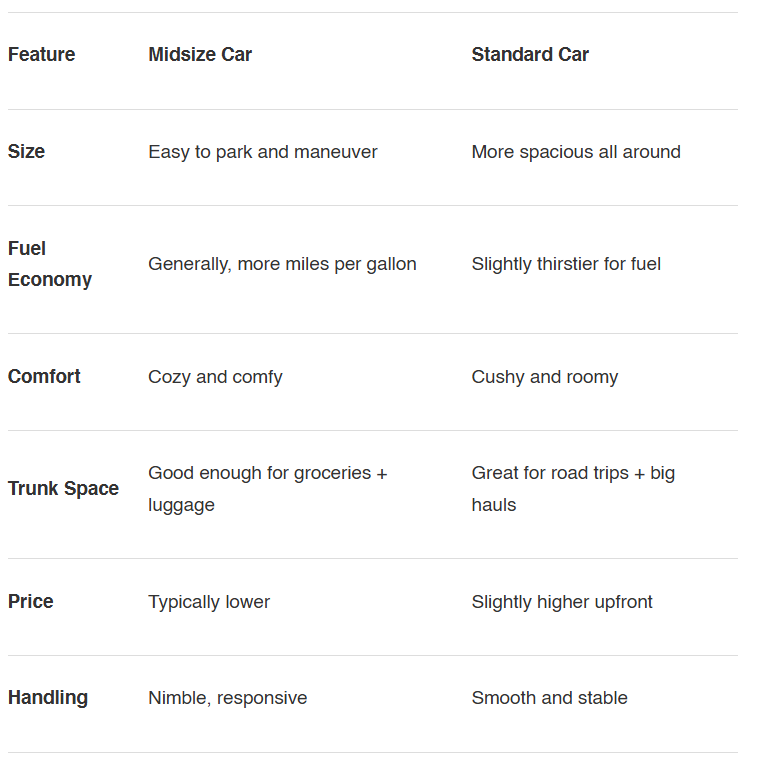
Key Differences at a Glance

Let’s make this super easy with a side-by-side:


Who’s the Midsize Car Made For?


Let’s say you’re a:

  • Commuter
  • Student
  • First-time car buyer
  • Parent with a young family
  • Anyone who wants something affordable and practical


A midsize sedan can be your car of choice. They are ideal vehicles when driving around town; they will have good gas mileage, and the maintenance budget will not be very high.


Pro Tip: Midsize cars are usually ahead in the salvage auto sales. Their components are readily affordable and are widely available, making repairs an easy process since it is cheap.


Who’s the Standard Car Really For?


Now, if you’re the type of person who:

  • Takes regular road trips
  • Drives with taller passengers
  • Hauls a lot of stuff (sports gear, strollers, you name it)
  • Just loves a smooth, luxurious ride


Then a standard/full-size sedan is more your speed. These cars feel closer to a luxury experience, with plush seats, bigger bodies, and a confident feel on the freeway.


Plus, if you’re browsing auction cars for sale, you can score a standard car at an unbelievable price that’s way lower than buying new.


Price Talk: New vs. Auction vs. Salvage


Here’s where it gets exciting, because let’s be honest, we all love a good deal.


Buying new? Standard cars usually cost more than midsize cars. But… if you’re exploring platforms like Salvage Reseller, you can flip the script. That luxurious full-size ride you thought was out of reach? Suddenly affordable.


At Salvage Reseller, you can:

  • Browse auction cars for sale from across the U.S.
  • Get access to both midsize and standard cars at deep discounts
  • Find salvage title vehicles that, with a little TLC, can be road-ready gems


So yeah, you can have champagne taste on a sparkling water budget.


Fuel Economy: The Ongoing Battle


Let’s get real. Gas isn’t cheap, and fuel efficiency matters.

  • Midsize cars: 25–35 MPG
  • Standard cars: 20–30 MPG

If your driving mostly includes work commutes and quick errands, midsize is probably your wallet’s best friend. But if comfort and space are non-negotiable, the MPG difference in standard cars is often worth it.


Insurance & Maintenance: What to Expect


One big perk of going with salvage car sales or auctions? Lower purchase price means lower insurance premiums in many cases.


But what about upkeep?

  • Midsize cars: Easier on the wallet for repairs and routine maintenance.
  • Standard cars: Might cost a bit more to service, but if you’re shopping smart (like through Salvage Reseller), your overall investment still comes out ahead.


And remember, title status plays a role too. Salvage cars are insurable (in most states) once they’re repaired and inspected. Just make sure to do your homework and get quotes before buying.


How Salvage Reseller Makes It Easy


Here’s why Salvage Reseller is the go-to spot for car buyers who love a good deal:

  • No dealer license required (huge win for everyday drivers!)
  • Access to thousands of auction cars for sale, both midsize and standard
  • Vehicle history reports, photos, and bidding made easy
  • Filters that help you search by vehicle size, location, condition, and more


This platform makes shopping enjoyable, transparent, and effective, regardless of whether you’re a DIY restorer or a bargain hunter.


Frequently Asked Questions

  1. Are salvage car sales a worthwhile alternative to buying a brand-new vehicle?


Absolutely. They offer reliable cars at a fraction of dealership prices, saving money while still delivering quality.


  1. What is the difference between midsize and standard cars in auctions or salvage sales?

Midsize cars are fuel-efficient and easy to handle. Standard cars provide extra space, comfort, and cargo room, both can be found at great deals.


  1. Are repairs for salvage cars typically more expensive than for regular cars?

Not usually. Midsize cars have affordable, widely available parts, and even standard cars still save money overall.


  1. Can salvage cars purchased from auctions be insured or financed?

Yes. Once repaired and inspected, they’re insurable. Financing depends on the lender, but auction prices often make an upfront payment feasible.


  1. How can someone start searching and buying cars from salvage car sales or auctions?

Use platforms like Salvage Reseller to browse thousands of listings, check vehicle histories, and bid confidently.


Final Thoughts: Which One’s Right for You?


It doesn’t have to be difficult to decide between a standard car and a midsize. After you are aware of the differences, it all boils down to what is most important: price, comfort, space, or fuel efficiency.


Salvage car sales are where many buyers find their sweet spot. At a fraction of the price, they allow you to access the same cars that you see at dealerships. More choices, greater value, and less financial strain result from this.


Salvage auctions allow you to get more car for your money, whether you’re looking for a roomy standard sedan or a nimble midsize.


So why pay too much? The next step is straightforward: look into salvage car sales, make your bid, and take home a deal that makes you happy.


Ready to Start Your Search?


Head over to Salvage Reseller and check out thousands of auction cars for sale today. From everyday drivers to road trip-ready rides, your perfect match is a bid away.


Clear Title vs. Clean Title: How Are They Different?

You’ve found a car that seems like a complete bargain, low price, good pictures, and exactly what you want. Then you get slammed by a bunch of baffling jargon: clean title, clear title, salvage title, rebuilt title vs clean title. And you’re no longer sure anymore.


What do they all mean? And most importantly, which one can you believe?


These title classifications aren’t mere technicalities; they’re the real history of any used car, from dealership lots to online auction sites such as Salvage Reseller. Disregard them, and you might just get yourself a big headache.


But don’t worry, we’ll explain everything in simple terms. Regardless of your level of experience, this guide will help you make safer, more informed, and more economical decisions.


What Is a Car Title, Anyway?


Before we dive into clean vs. clear vs. salvage vs. rebuilt, let’s cover the fundamentals.

A car title is a formal document from your state’s DMV. It establishes who owns the vehicle and contains important information such as:


  • The owner’s name
  • The VIN (Vehicle Identification Number)
  • The make, model, and year
  • The odometer reading
  • And most importantly: the title status


The title status reveals to you the type of history the vehicle has: has it been wrecked, fixed, or does it still have finance on it? And that’s where the fun begins.


Clean Title vs. Clear Title: What’s the Difference?


Here is where everyone gets lost. Clean title and clear title are very close, sounding itchy, and, actually, they are similar in meaning, often being used as synonyms, but they are not synonyms.


Let’s put it all out in a side-by-side comparison:


Clean Title vs. Clear Title: Quick Comparison


In plain language:


A clean title is used to refer to the fact that the car has not been written off or seriously damaged.


Free and clear means that there are no liens, no loans, no bank, nothing on the home page; a clear title is a pure title. 


A car might have a clean title but not a clear title if the owner still owes cash on it. And that becomes important when the time comes to sell it.


So What’s a Salvage Title, Then?


If a clean title is the gold standard, a salvage title is the red flag, but not always in a negative sense.


A salvage title is given when a vehicle is severely damaged, so severely that an insurance company determines it is not worth repairing. This can occur as a result of:

  • Serious accidents
  • Flood damage
  • Theft recovery
  • Fire damage


It doesn’t necessarily mean the car is worthless. It just means repairing it was more expensive than it was worth then.


Here’s the best part: a salvage title vehicle can be a treasure trove if you understand how to work it. Lots of consumers purchase these cars at auction from sites such as Salvage Reseller, refurbish them, and drive them or sell them for a profit.


What Is a Rebuilt Title, Then?


After a salvage title vehicle is repaired and inspected, the DMV may issue a rebuilt title.


Which means:

  • The vehicle was previously deemed to be a total loss.
  • It’s been repaired and is once again legal to drive.
  • The history remains on the record, but the vehicle is safe to drive.


View it as a comeback story. The vehicle had a difficult time but survived.


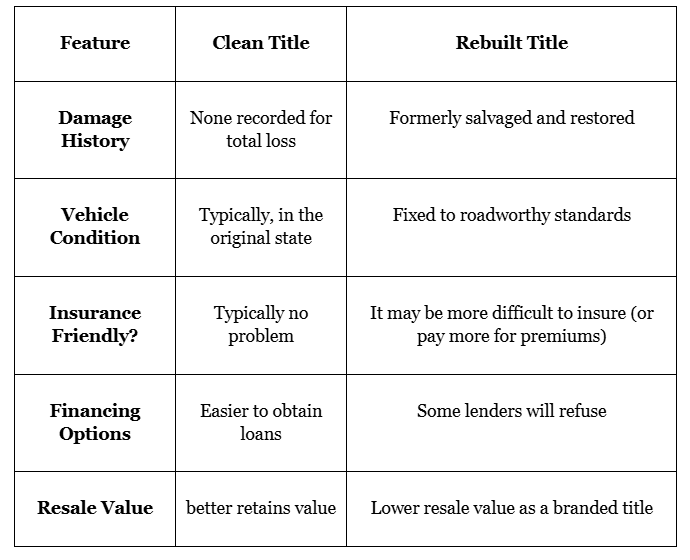
Rebuilt Title vs. Clean Title: Key Differences

Here’s a quick comparison of how rebuilt titles compare to clean titles:


So, Which One Should You Choose?


Here’s the reality: it matters about your objectives.


Opt for a Clean & Clear Title Car when:

  • You desire peace of mind.
  • You don’t like surprises.
  • You prefer simple insurance and resale.
  • You’re purchasing a car for everyday driving or for your family.


Opt for a Rebuilt or Salvage Title Car when:

  • You’re handy or have a trusted mechanic.
  • You’re on a budget and desire the best bang for your buck.
  • You’re fine with making some repairs (or already intend to).
  • You’re considering auctions from Salvage Reseller as a good bargain.


Just be sure to enter with your eyes open. Not all salvage vehicles are worth it, and not all clean title vehicles are perfect.


Must-Know Tips Before You Buy


Regardless of which title type you’re considering, here are some important steps to safeguard yourself:


  1. Inspect the Title Type.

Don’t take anything for granted; check the title status on the ad or ask the seller directly.


  1. Do a Vehicle History Report.

Take the VIN and obtain an in-depth history through Carfax, AutoCheck, or an equivalent service.


  1. Request Photos or an Inspection.

Particularly if purchasing online. Most auction sites (such as Salvage Reseller) provide high-res photos and inspection reports.


  1. Familiarize Yourself with Your State Laws.

Each state has varying regulations on salvage and rebuilt titles. Some have additional inspections or documentation.


  1. Budget for Insurance and Repairs.

Rebuilt or salvage vehicles are sometimes bargains initially, but will cost more over time. Think ahead.


Frequently Asked Questions (FAQ)


  1. What is the key difference between a rebuilt title and a clean title?

A clean title means no major total loss history, while a rebuilt title indicates a previously salvaged car that’s been repaired, inspected, and deemed roadworthy again.


  1. Is it worth buying a salvage title car from an auction site?

A salvage title car can be worth it if you understand repair costs, review inspection details, and accept potential insurance or financing limitations before purchase.


  1. Can a vehicle have a clean title but not a clear title?

Yes, a car may have a clean title with no total loss history, but still carry outstanding loans or liens preventing immediate ownership transfer.


  1. How do insurance companies treat a rebuilt title vs a clean title vehicle?

Insurance is generally easier and cheaper with clean titles, while rebuilt title cars may have higher premiums or limited coverage due to higher risk factors.


  1. Why are salvage title cars usually cheaper than clean title vehicles?

They cost less because of prior damage, reduced resale value, and potential insurance challenges. Buyers trade peace of mind for upfront savings and repair opportunities.


Final Thoughts


You have now realised that car titles are not just about paperwork; they are an entry to the past of a vehicle.


A clean title can look flawless on the surface. A clear title provides you with peace of mind as a homeowner. A salvage title vehicle may be a gem in the rough. And a rebuilt title? That’s a rags-to-riches story with some serious potential.


Knowing the difference between a rebuilt title and a clean title is ahead of the game and saves you costly blunders. It’s simply about finding the right title for your needs, your budget, and your risk tolerance.


And you may start bidding with confidence at Salvage Reseller when you’re prepared to look for your next car, whether it’s clean, clear, or a fixer-upper.