

Wh Auction Cars Sell Below Market Valuey Some

When browsing vehicles at car auctions, many first-time buyers notice something surprising. Some vehicles sell for far less than their estimated market value.


At first glance, this may seem strange. If a car is worth $15,000 on the market, why would it sell for $6,000 or $7,000 at auction? The answer is that auction pricing works very differently from traditional dealership pricing.


Understanding these differences helps buyers recognize real opportunities — and avoid misunderstandings about how auction markets function.


What “Estimated Value” Actually Means


Most auction listings include an estimated retail valueThis number is usually based on the vehicle’s market value if it were sold in normal retail condition, typically calculated using industry valuation guides.


However, that number does not mean the vehicle will sell for that price. It simply provides a reference point for buyers. Several important factors influence the final auction price.


Repairs and Unknown Damage


One of the biggest reasons auction vehicles sell for less than their estimated value is the possibility of repairs. Even when damage appears minor in photos, buyers must consider the cost of:


  • Replacement parts

  • Labor costs

  • Paint work

  • Mechanical issues

  • Hidden structural damage


Because these costs are uncertain until the vehicle is inspected or repaired, buyers naturally bid more conservatively. The potential repair cost reduces what buyers are willing to pay upfront.


Risk and Uncertainty


Traditional dealerships inspect, repair, and recondition vehicles before selling them. Auction buyers take on more responsibility.


That means buyers must account for risks such as:


  • Unknown mechanical problems

  • Title limitations

  • Transportation costs

  • Storage fees if pickup is delayed


Since buyers assume these risks, they adjust their bids accordingly. Lower bids help offset potential surprises after purchase.


Sellers Prioritize Speed


Many vehicles at auction are sold by organizations that prioritize speed rather than maximum retail profit. These can include:


  • Insurance companies

  • Banks repossessing vehicles

  • Fleet operators

  • Rental companies


Their goal is to recover value quickly and move inventory. Holding a vehicle longer can mean additional storage costs and continued depreciation. As a result, selling through auction — even at a lower price — is often the most efficient financial decision.


Market Competition Matters


Auction prices are also influenced by simple market demand. If many buyers are interested in the same vehicle, the bidding may drive the price closer to market value. However, if fewer buyers are competing, the vehicle may sell for significantly less.


This is why two very similar vehicles can sell for very different prices depending on the level of competition during the auction.


Timing Can Affect Auction Prices


The timing of an auction can also impact the final price. For example:


  • Some auctions take place during hours when fewer buyers are online

  • Seasonal demand can change what buyers are looking for

  • Market trends can influence specific vehicle types


These timing factors sometimes create unexpected deals.


Transportation Costs Influence Bidding


Many buyers must ship vehicles from the auction yard to their location. Transportation costs can significantly affect what buyers are willing to bid. If a vehicle is located far from most buyers, demand may be lower — which can lead to a lower final auction price.


Buyers closer to the auction location may have an advantage in these situations.


Not Every Cheap Car Is a Good Deal


While auction vehicles sometimes sell below estimated value, buyers should always evaluate the full picture. A low price may reflect:


  • Repair costs

  • Title restrictions

  • Limited demand

  • Transportation challenges


Understanding these factors helps buyers determine whether a vehicle is truly a good opportunity.


Why Auctions Create Opportunities


Because auctions involve uncertainty, competition, and time-sensitive sales, they often produce prices that differ from traditional retail markets. For informed buyers, this environment can create real savings.


The key is learning how to evaluate vehicles, understand potential risks, and calculate the true cost before bidding. Once buyers understand these dynamics, the auction marketplace becomes far less mysterious — and far more strategic.
Why Insurance Companies Sell Vehicles Through Auctions

If you’ve ever browsed vehicles on SalvageReseller, you’ve probably noticed that many listings come from insurance companies. This often raises a question:

Why would an insurance company sell vehicles at auction instead of fixing them or selling them privately?


The answer has everything to do with economics, risk management, and operational efficiency. Understanding this helps buyers see the bigger picture — and make smarter decisions.


What Happens After an Insurance Claim


When a vehicle is involved in an accident, flood, theft recovery, or other insured loss, the insurance company evaluates the cost of repair versus the vehicle’s market value.


If the repair cost exceeds a certain percentage of the vehicle’s value, the insurance company may declare it a total loss.


At that point:

  • The insurance company pays the policyholder

  • The vehicle becomes the property of the insurance company

  • The company must recover as much value as possible from that asset


This is where auctions come in.


Auctions Are the Fastest Way to Recover Value


Insurance companies process thousands of claims every month.


They are not dealerships.
They are not repair shops.
They are not long-term vehicle owners.


Their goal is simple: Recover capital quickly and efficiently.


Auctions allow them to:

  • Sell vehicles in large volumes

  • Reach a nationwide buyer base

  • Move inventory quickly

  • Avoid storage and depreciation losses


Instead of negotiating one car at a time, auctions create immediate market exposure.


Why Insurance Companies Don’t Repair and Resell


Many buyers wonder:Why don’t insurance companies just fix the car and sell it retail? There are several reasons:


1. Repair Risk

Repair costs can increase once work begins. Hidden damage can turn a repair into a financial loss.


2. Liability Concerns

Once repaired, the company could face legal exposure if the vehicle has future issues.


3. Operational Focus

Insurance companies specialize in underwriting risk — not managing body shops.


4. Time Efficiency

Repairing and reselling vehicles would slow down their claim cycle and tie up capital.


Selling through auction transfers the repair risk to buyers who specialize in rebuilding, exporting, or reselling.


Why Auctions Make Sense for Buyers


From a buyer’s perspective, this system creates opportunity. Because insurance companies are focused on:


  • Speed

  • Volume

  • Capital recovery


They often prioritize liquidation over maximizing retail profit.


This allows:

  • Rebuilders to purchase repairable vehicles

  • Exporters to access inventory at scale

  • Dealers to source inventory below market value

  • Individuals to buy vehicles for less than traditional retail pricing


Auctions create price discovery through competition.


What This Means for SalvageReseller Buyers


SalvageReseller gives public buyers access to the same insurance inventory that licensed dealers bid on.Through the platform, buyers can:


  • View insurance-listed vehicles

  • See detailed condition reports

  • Calculate estimated total costs

  • Check transportation pricing

  • Participate in auctions without a dealer license


Insurance companies supply the inventory. Copart hosts the auction. SalvageReseller provides access and transparency.


Important: Insurance Vehicles Are Not All the Same


Not every insurance vehicle is severely damaged. Insurance companies may sell vehicles due to:


  • Minor accident damage

  • Hail damage

  • Theft recovery

  • Flood exposure

  • Cosmetic issues

  • High repair labor costs


Sometimes, the repair estimate exceeds value not because the vehicle is destroyed — but because labor rates, part costs, or internal policies make repair uneconomical for the insurer. That difference is where opportunity often exists.


Why This System Continues to Grow


The auction model works because it benefits all parties:


  • Insurance companies recover capital quickly

  • Auction platforms handle logistics

  • Buyers gain access to discounted inventory

  • Brokers like SalvageReseller make it accessible to the public


As repair costs rise and vehicles become more complex, insurance companies are increasingly likely to total vehicles rather than repair them. That means auction inventory will likely continue to grow.


Final Thoughts


Insurance companies don’t sell vehicles at auction because they are bad vehicles.


They sell them because: It is the most efficient financial decision. Understanding this changes how you view auction cars. Instead of asking: “Why is this car at auction?”


The better question is: “Does this vehicle make sense for my situation and budget?”


And with the tools available on SalvageReseller — including cost calculators, estimated totals, and transportation pricing — buyers can make that decision with clarity.

Who Really Controls How Auction Cars Are Sold

One of the biggest misconceptions among buyers is assuming that SalvageReseller decides when a vehicle becomes Buy It Now. That’s not the case.


  • Copart controls the auction format

  • The seller (insurance company, dealer, fleet owner) sets the rules

  • SalvageReseller displays those options and allows you to buy or bid as a Copart-authorized broker


When a vehicle switches from auction to Buy It Now, it’s because the seller has changed their strategy, not because the platform did.


The Most Common Triggers That Activate Buy It Now


1. The Vehicle Failed to Sell at Auction


This is the most common trigger. When a vehicle:


  • Receives bids

  • But does not meet the seller’s reserve price

  • And goes unsold


The seller may decide to:


  • Stop waiting for future auction cycles

  • Avoid additional listing and storage fees

  • Set a fixed Buy It Now price to move the vehicle faster


This is especially common after multiple auction runs.


2. The Seller Wants a Guaranteed Sale Price


Auctions are unpredictable. Even popular vehicles can:


  • Attract low bids

  • Miss reserve by a small margin

  • Stall due to timing or market conditions


By switching to Buy It Now, the seller:


  • Locks in a minimum acceptable price

  • Removes bidding uncertainty

  • Allows immediate purchase


For buyers, this can mean less competition and no bidding pressure.


3. Low or Inconsistent Bidding Activity


If a vehicle shows:

  • Many watchers but few bids

  • Bids that stall early

  • No competitive momentum


The seller may interpret that as weak auction demand and convert the listing to Buy It Now. This often happens with:


  • Specialty vehicles

  • High-end cars

  • Vehicles that need a specific buyer profile


4. Time Pressure on the Seller’s Side


Some sellers operate under internal deadlines. Examples include:


  • Insurance inventory aging limits

  • End-of-quarter clearance

  • Yard capacity constraints


When time becomes more important than maximizing price, Buy It Now becomes the fastest exit strategy.


5. Market Conditions Changed


Vehicle values fluctuate constantly. A seller may adjust strategy when:


  • Similar vehicles start selling for less

  • Market demand cools

  • Seasonal trends shift


Rather than risk repeated auction failures, the seller may switch to Buy It Now while pricing is still competitive.


Why Buy It Now Can Be a Strategic Advantage for Buyers


Many experienced buyers actively look for Buy It Now vehicles.


Here’s why:

  • No bidding wars

  • No waiting for auction day

  • No risk of being outbid at the last second

  • Immediate price certainty


On SalvageReseller, you can also:


  • See the final estimated cost upfront

  • Use the cost calculator to factor in fees and transportation

  • Decide instantly whether the deal makes sense for your budget


Important Detail: Buy It Now Can Disappear


Buy It Now is not permanent.

If:

  • The seller removes the option

  • The vehicle is relisted

  • Market conditions change


The listing may return to auction format. That’s why timing matters.

If Buy It Now fits your numbers, waiting too long can mean losing the opportunity.


How SalvageReseller Helps You Decide Faster


When a vehicle switches to Buy It Now on SalvageReseller, you can immediately:


  • See the Buy It Now price

  • Review vehicle details and condition

  • Calculate your estimated total cost

  • Check transportation estimates

  • Move forward without waiting for auction approval


This transparency is critical, especially for buyers who don’t want surprises after committing.


Final Thoughts


A vehicle doesn’t switch from auction to Buy It Now by accident. It happens because:


  • The seller wants certainty

  • The auction didn’t deliver the desired result

  • Time, cost, or market conditions changed


Knowing these triggers helps you read the market, spot real opportunities, and act with confidence.


And when you see a Buy It Now option that makes sense, remember: someone else may be looking at the same listing right now.

Why Two Buyers Can Pay Very Different Prices for the Same Auction Car

At online vehicle auctions, it’s common for two buyers to look at the exact same car and end up paying very different total prices.

Same vehicle, same auction, very different results.

This difference has little to do with luck. It comes down to how each buyer evaluates costs, timing, and logistics before committing to a purchase.


The Illusion of the “Cheap” Auction Price


Most buyers focus on a single number: the current bid.

That number feels like the price of the car, but in reality, it’s only one part of the equation. Two buyers can see the same bid and still walk away with completely different total costs.

The mistake is assuming the auction price equals the final price. It never does.


Where the Price Gap Really Comes From


Several factors explain why buyers pay different totals for the same vehicle. These differences usually appear before the bid is even placed.


1. Different Buying Methods


One buyer bids aggressively and wins the auction. Another buyer uses Buy It Now at the right moment.


Buy It Now often helps buyers avoid:

  • Bidding wars

  • Emotional overbidding

  • Extended auction timelines


Even if Buy It Now looks higher upfront, the final cost can be lower once fees and delays are considered.


2. Transportation Planning (or Not Planning at All)


Transportation is one of the biggest cost variables.

Some buyers:

  • Check transport estimates before bidding

  • Compare open vs enclosed delivery

  • Factor distance into their budget


Others only think about shipping after winning.

That’s how one buyer pays a reasonable transport cost while another faces a surprise bill that wipes out their savings.


3. Location Has a Bigger Impact Than Most Buyers Expect


The same vehicle in two different auction yards can have very different delivery costs.

Buyers who:

  • Consider proximity

  • Compare similar vehicles in closer locations


often pay less overall than buyers chasing the lowest bid hundreds of miles away. Smart buyers shop location as much as price.


4. Timing and Competition Awareness


Auction timing matters.


Some buyers:

  • Bid early

  • Attract competition

  • Push prices higher


Others:

  • Monitor activity

  • Set firm limits

  • Walk away when numbers stop making sense


The second group consistently secures better deals.


5. Tools Versus Guesswork


This is where the real difference appears. Buyers who use SalvageReseller tools can:


  • Estimate total purchase cost

  • Compare Buy It Now versus auction scenarios

  • Preview transportation expenses

  • Avoid emotional decisions


Buyers who guess rely on hope. Hope is expensive.


A Simple Example


Two buyers want the same vehicle.

Buyer A:

  • Wins after multiple bids

  • Pays more than planned

  • Calculates transport after winning

Buyer B:

  • Uses Buy It Now

  • Reviews the final price calculator

  • Confirms transportation costs upfront


Buyer B pays less, gets the vehicle faster, and avoids stress. Same car, different strategy.


Why Experienced Buyers Focus on Total Cost


Seasoned buyers don’t chase the lowest bid.


They focus on:

  • Predictability

  • Controlled risk

  • Clear totals

  • Faster execution


That mindset leads to better long-term results.


How SalvageReseller Levels the Playing Field


SalvageReseller is designed around transparency.


Buyers can:

  • Compare Buy It Now and auction pricing

  • Estimate total costs before bidding

  • Calculate transportation using ZIP code-based estimates

  • Make decisions with full visibility


This gives everyday buyers access to the same tools professionals rely on.


Final Thought


Two buyers can look at the same auction car and walk away with completely different outcomes.

The difference isn’t the car. It’s the process.

Buy smarter, not just cheaper.

Midsize vs. Standard Cars: What’s the Real Difference & Which One Fits You Best?

It’s not always necessary to pay the full price at the dealership to purchase a car. Salvage car sales are a gold mine for bargain hunters who can find the ideal vehicle for a fraction of the price.


Whether you are looking to purchase a midsize sedan styled for the daily commute or a full-size car with lots of space and comfort, you will find a large variety of cars at a salvage sale. The secret is determining what each type has to offer, and which is most suitable to your lifestyle:


The first step is to comprehend the distinctions between standard and midsize cars. It’s much simpler to navigate salvage car sales once you know what to look for.


What’s the Difference Between Midsize and Standard Cars?

Alright, first things first. Let’s clear up this whole “midsize” vs. “standard” mystery.


Midsize Cars


Midsize cars can be thought of as a Goldilocks option between cars that are too small or too large. They are ideal to drive every day, running into stores, commuting, as well as short trips on weekends. The most popular models in this category are:


  • Toyota Camry
  • Honda Accord
  • Nissan Altima
  • Hyundai Sonata


They’re roomy enough for a family of five but compact enough to squeeze into a tight parking spot. Plus, they tend to sip fuel instead of guzzling it. Win-win.


Standard (Full-Size) Cars


Now we’re talking size and comfort. These are larger sedans made for serious legroom, smooth highway cruising, and maximum trunk space. Models like:

  • Chevrolet Impala
  • Ford Taurus
  • Toyota Avalon
  • Chrysler 300


These are the cars you rent for a road trip and think, “Wow, this is comfy.” If you’ve got passengers or cargo, or both, these cars are built to handle it.


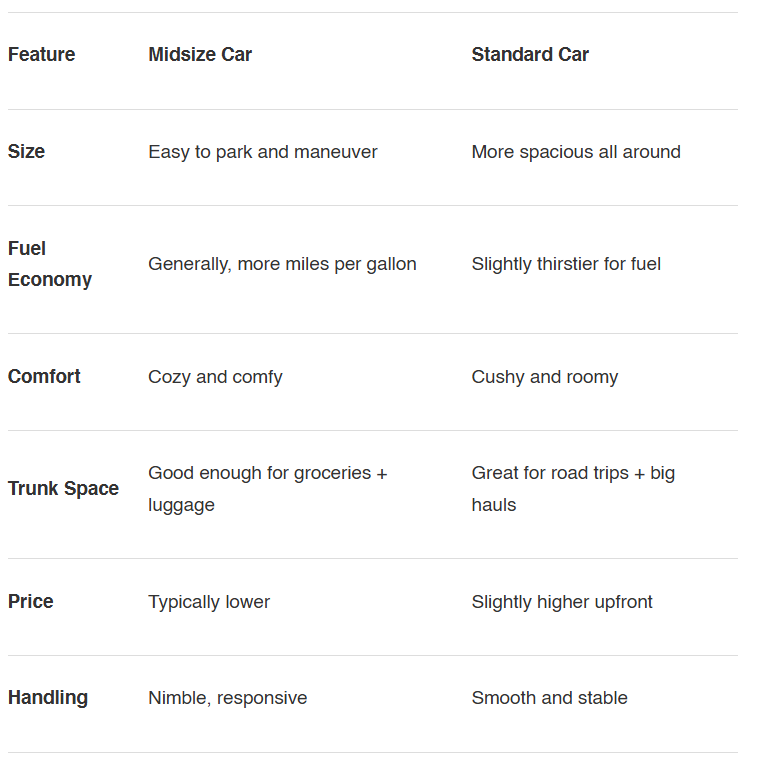
Key Differences at a Glance

Let’s make this super easy with a side-by-side:


Who’s the Midsize Car Made For?


Let’s say you’re a:

  • Commuter
  • Student
  • First-time car buyer
  • Parent with a young family
  • Anyone who wants something affordable and practical


A midsize sedan can be your car of choice. They are ideal vehicles when driving around town; they will have good gas mileage, and the maintenance budget will not be very high.


Pro Tip: Midsize cars are usually ahead in the salvage auto sales. Their components are readily affordable and are widely available, making repairs an easy process since it is cheap.


Who’s the Standard Car Really For?


Now, if you’re the type of person who:

  • Takes regular road trips
  • Drives with taller passengers
  • Hauls a lot of stuff (sports gear, strollers, you name it)
  • Just loves a smooth, luxurious ride


Then a standard/full-size sedan is more your speed. These cars feel closer to a luxury experience, with plush seats, bigger bodies, and a confident feel on the freeway.


Plus, if you’re browsing auction cars for sale, you can score a standard car at an unbelievable price that’s way lower than buying new.


Price Talk: New vs. Auction vs. Salvage


Here’s where it gets exciting, because let’s be honest, we all love a good deal.


Buying new? Standard cars usually cost more than midsize cars. But… if you’re exploring platforms like Salvage Reseller, you can flip the script. That luxurious full-size ride you thought was out of reach? Suddenly affordable.


At Salvage Reseller, you can:

  • Browse auction cars for sale from across the U.S.
  • Get access to both midsize and standard cars at deep discounts
  • Find salvage title vehicles that, with a little TLC, can be road-ready gems


So yeah, you can have champagne taste on a sparkling water budget.


Fuel Economy: The Ongoing Battle


Let’s get real. Gas isn’t cheap, and fuel efficiency matters.

  • Midsize cars: 25–35 MPG
  • Standard cars: 20–30 MPG

If your driving mostly includes work commutes and quick errands, midsize is probably your wallet’s best friend. But if comfort and space are non-negotiable, the MPG difference in standard cars is often worth it.


Insurance & Maintenance: What to Expect


One big perk of going with salvage car sales or auctions? Lower purchase price means lower insurance premiums in many cases.


But what about upkeep?

  • Midsize cars: Easier on the wallet for repairs and routine maintenance.
  • Standard cars: Might cost a bit more to service, but if you’re shopping smart (like through Salvage Reseller), your overall investment still comes out ahead.


And remember, title status plays a role too. Salvage cars are insurable (in most states) once they’re repaired and inspected. Just make sure to do your homework and get quotes before buying.


How Salvage Reseller Makes It Easy


Here’s why Salvage Reseller is the go-to spot for car buyers who love a good deal:

  • No dealer license required (huge win for everyday drivers!)
  • Access to thousands of auction cars for sale, both midsize and standard
  • Vehicle history reports, photos, and bidding made easy
  • Filters that help you search by vehicle size, location, condition, and more


This platform makes shopping enjoyable, transparent, and effective, regardless of whether you’re a DIY restorer or a bargain hunter.


Frequently Asked Questions

  1. Are salvage car sales a worthwhile alternative to buying a brand-new vehicle?


Absolutely. They offer reliable cars at a fraction of dealership prices, saving money while still delivering quality.


  1. What is the difference between midsize and standard cars in auctions or salvage sales?

Midsize cars are fuel-efficient and easy to handle. Standard cars provide extra space, comfort, and cargo room, both can be found at great deals.


  1. Are repairs for salvage cars typically more expensive than for regular cars?

Not usually. Midsize cars have affordable, widely available parts, and even standard cars still save money overall.


  1. Can salvage cars purchased from auctions be insured or financed?

Yes. Once repaired and inspected, they’re insurable. Financing depends on the lender, but auction prices often make an upfront payment feasible.


  1. How can someone start searching and buying cars from salvage car sales or auctions?

Use platforms like Salvage Reseller to browse thousands of listings, check vehicle histories, and bid confidently.


Final Thoughts: Which One’s Right for You?


It doesn’t have to be difficult to decide between a standard car and a midsize. After you are aware of the differences, it all boils down to what is most important: price, comfort, space, or fuel efficiency.


Salvage car sales are where many buyers find their sweet spot. At a fraction of the price, they allow you to access the same cars that you see at dealerships. More choices, greater value, and less financial strain result from this.


Salvage auctions allow you to get more car for your money, whether you’re looking for a roomy standard sedan or a nimble midsize.


So why pay too much? The next step is straightforward: look into salvage car sales, make your bid, and take home a deal that makes you happy.


Ready to Start Your Search?


Head over to Salvage Reseller and check out thousands of auction cars for sale today. From everyday drivers to road trip-ready rides, your perfect match is a bid away.